
7 Hidden Signs Your Building Is Wasting Energy (And How to Fix Them)

Updated: Jul 28
Energy costs continue to rise, making efficient building operations more important than ever. Yet many commercial buildings, offices, factories, hospitals and educational institutions unknowingly waste thousands of Ringgit each year due to hidden inefficiencies.
The challenge is that energy waste is not always obvious. Equipment may still be functioning normally while consuming significantly more electricity than necessary.
By recognising the warning signs early, organisations can improve operational efficiency, lower utility bills and extend the lifespan of critical building assets.
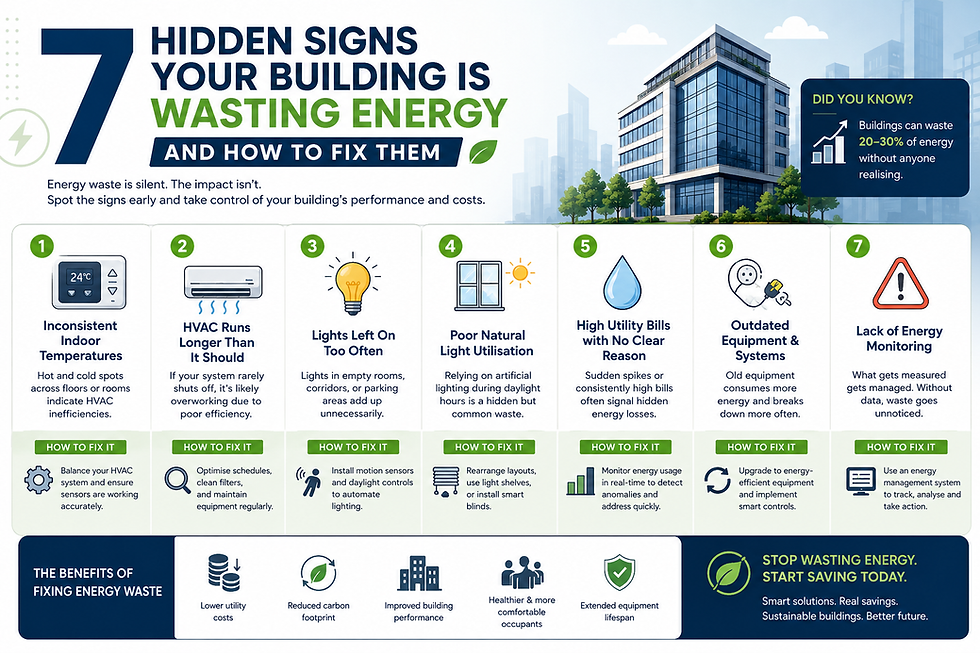
1. Your Electricity Bill Keeps Increasing Without Operational Changes
One of the earliest indicators of energy inefficiency is a steady increase in electricity costs despite no significant change in occupancy or operating hours.
Possible causes include:
Aging HVAC equipment
Inefficient chillers
Faulty control systems
Increased standby power consumption
Equipment operating outside optimal settings
Regular energy monitoring helps identify where additional energy is being consumed before costs escalate further.
2. HVAC Systems Run Longer Than Necessary
Heating, ventilation and air conditioning (HVAC) systems typically account for the largest portion of a commercial building's electricity consumption.
If your cooling system continues running after office hours or struggles to maintain indoor temperatures, it may indicate:
Dirty air filters
Poor airflow
Incorrect thermostat settings
Sensor calibration issues
Equipment degradation
Optimising HVAC operations can significantly reduce energy consumption while maintaining occupant comfort.
3. Occupants Frequently Complain About Temperature
If some areas of the building are too cold while others remain too warm, your building may have an imbalance in its air distribution system.
Common reasons include:
Damaged dampers
Poor zoning design
Blocked air ducts
Faulty sensors
Aging HVAC equipment
Comfort issues often signal deeper operational inefficiencies that increase energy use.
4. Equipment Requires Frequent Emergency Repairs
Repeated equipment failures often indicate that assets are operating under unnecessary stress. Emergency maintenance is typically more expensive than planned maintenance and frequently results in additional downtime.
Implementing predictive maintenance allows facility managers to identify potential failures before they become critical.
5. Building Systems Operate Independently
Many buildings still manage lighting, HVAC, water systems and energy monitoring separately.
Without integrated building management systems, organisations lose opportunities to:
Optimise equipment schedules
Reduce overlapping energy consumption
Detect abnormal energy usage
Improve operational visibility
Digital integration enables smarter, data-driven decision-making.
6. Energy Consumption Is Not Measured in Real Time
Many organisations only review electricity usage when they receive their monthly utility bill. Unfortunately, by then, energy waste has already occurred.
Real-time monitoring provides immediate visibility into:
Peak demand
Equipment performance
Energy trends
Abnormal consumption
System faults
This enables corrective action before unnecessary costs accumulate.
7. Your Building Still Relies Solely on Manual Inspections
Manual inspections remain valuable but cannot continuously monitor every critical asset.
With IoT sensors and AI-powered analytics, facility teams gain continuous insight into building performance, enabling:
Early fault detection
Energy optimisation
Automated alerts
Better maintenance planning
Improved operational reliability
Digital technologies complement maintenance teams rather than replace them.
How Smart Energy Management Solves These Problems
Modern energy management combines technology, data and operational expertise to continuously improve building performance.
An effective smart energy management programme typically includes:
Real-time energy monitoring
HVAC performance optimisation
AI-powered fault detection
Predictive maintenance
Equipment performance analytics
Energy reporting dashboards
Continuous improvement recommendations
Instead of reacting to rising costs, organisations can proactively improve efficiency and reduce operational risks.
The Business Benefits
Organisations that actively monitor and optimise energy usage often experience:
Lower operating costs
Improved equipment reliability
Reduced unplanned downtime
Longer asset lifespan
Better occupant comfort
Enhanced sustainability performance
Stronger ESG reporting capabilities
These improvements contribute to both financial savings and long-term operational resilience.
Why Partner with IS Ikhlas Suci?
At IS Ikhlas Suci, we help organisations transform building operations through intelligent energy management, AI-driven monitoring and smart facility solutions.
Our approach focuses on identifying inefficiencies, optimising equipment performance and delivering measurable improvements in energy efficiency, operational reliability and sustainability.
Whether managing an office building, healthcare facility, industrial plant or educational campus, our solutions are designed to help clients reduce costs while building smarter, more resilient facilities.
Conclusion
Energy waste is rarely caused by a single major issue. More often, it results from multiple small inefficiencies that go unnoticed over time.
By identifying these hidden warning signs and adopting smart energy management practices, organisations can reduce operational costs, improve equipment performance and create healthier, more sustainable buildings.
Investing in energy efficiency today not only lowers expenses but also prepares your organisation for a more sustainable and data-driven future.


Comments