

Commercial Cleaning Services in Malaysia: What Makes a Professional Cleaning Strategy Effective?

Updated: Sep 21
Cleanliness is one of the most visible aspects of facility management.
A building may have sophisticated air-conditioning systems, energy-efficient equipment and modern architecture, but if its floors are dirty, washrooms are poorly maintained or common areas are neglected, occupants and visitors will notice immediately.
For commercial buildings, cleaning is therefore more than a routine housekeeping activity. It is an essential part of facility performance, hygiene, safety, employee experience and brand reputation.
However, effective commercial cleaning requires more than simply assigning cleaners to different areas.
It requires the right people, processes, equipment, schedules, quality controls and management systems.
So, what makes a professional cleaning strategy effective?
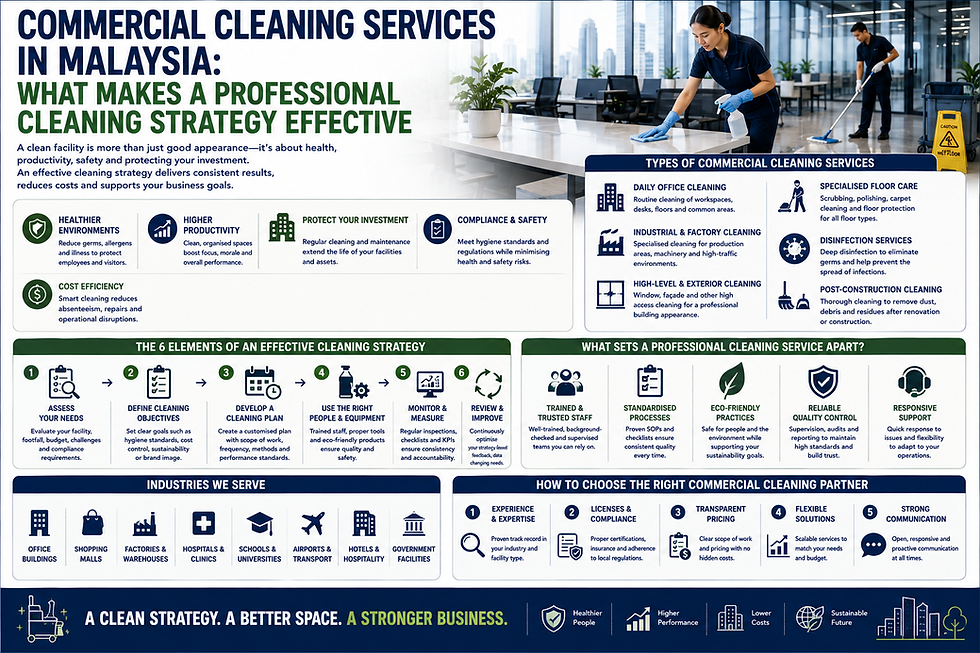
Cleaning Is a Facility Management Function, Not Just a Daily Task
Traditional cleaning operations often focus on completing a checklist:
Sweep the floor
Mop the floor
Empty bins
Clean toilets
Wipe surfaces
Refill supplies
These tasks remain important, but modern facilities require a more structured approach.
A professional cleaning strategy considers what needs to be cleaned, how frequently it should be cleaned, what standard is required and how performance will be measured.
Different areas of a building also have different requirements.
A corporate office, hospital, shopping mall, school and industrial facility cannot all use exactly the same cleaning programme.
The cleaning strategy should reflect the building's:
Occupancy
Foot traffic
Operating hours
Type of users
Risk level
Facility layout
Surface materials
Hygiene requirements
Business activities
1. Start With a Proper Cleaning Assessment
Before implementing a cleaning programme, facility managers should understand the building.
A professional assessment can identify high-traffic and high-risk areas, existing cleaning gaps and opportunities to improve resource allocation.
Typical areas include:
High-Traffic Areas
These may include:
Main entrances
Lobbies
Corridors
Lifts
Escalators
Reception areas
Food and beverage areas
These spaces generally require greater attention because they experience frequent use.
High-Touch Surfaces
Door handles, lift buttons, handrails and other frequently touched surfaces require appropriate cleaning and hygiene procedures.
Washrooms
Washrooms require particularly close attention because cleanliness, odour, consumables and overall condition can significantly affect user experience.
Back-of-House Areas
Staff areas, loading bays, waste collection points and service corridors can have different cleaning requirements from public areas.
A cleaning plan should therefore be based on the actual facility rather than a generic checklist.
2. Cleaning Frequency Should Follow Building Usage
One of the most common mistakes in cleaning management is treating every area equally.
Not every room needs to be cleaned at the same frequency.
A meeting room used twice a week does not necessarily require the same cleaning frequency as a busy lobby used by thousands of people every day.
A more effective approach is to classify areas according to usage and risk.
Area | Typical Consideration |
Lobby | High traffic and visibility |
Washroom | Hygiene and frequent inspection |
Lift | High-touch surfaces and traffic |
Office | Occupancy and working hours |
Pantry | Food hygiene and waste |
Warehouse | Dust, safety and operational activity |
Outdoor areas | Weather and environmental conditions |
This approach allows cleaning resources to be deployed where they provide the greatest operational value.
3. Professional Cleaning Requires the Right Equipment
Cleaning technology has evolved significantly.
Modern commercial cleaning operations can use equipment such as:
Automated floor scrubbers
High-efficiency vacuum systems
Microfibre cleaning systems
Pressure washers
High-speed floor machines
Specialist carpet-cleaning equipment
Washroom cleaning equipment
The right equipment can improve consistency and productivity while reducing unnecessary manual effort.
However, technology should not replace proper cleaning procedures.
Equipment selection should consider the building's floor surfaces, operating environment, accessibility and cleaning requirements.
4. Cleaning Chemicals Need to Be Managed Properly
Using more cleaning chemicals does not necessarily mean achieving better results.
Professional cleaning operations need appropriate chemical selection, dilution, storage and application.
Incorrect chemical use can:
Damage surfaces
Create unpleasant odours
Increase operating costs
Create safety risks
Reduce cleaning effectiveness
Cleaning teams should therefore receive proper training and follow established procedures for chemical handling.
Where appropriate, organisations can also consider environmentally preferable cleaning products as part of broader sustainability objectives.
5. Staff Training Makes a Major Difference
A cleaning strategy is only as effective as the people implementing it.
Professional cleaning teams need to understand:
Cleaning procedures
Equipment operation
Chemical handling
Personal protective equipment
Hygiene practices
Waste management
Safety procedures
Incident reporting
Customer service
Training should also be ongoing.
New equipment, new cleaning products, changing building requirements and evolving safety standards can all require additional training.
A well-trained team is more likely to deliver consistent results and identify problems before they become larger issues.
6. Quality Control Should Be Measurable
One of the biggest differences between basic cleaning and professional cleaning management is quality control.
Instead of simply asking whether an area was cleaned, facility managers should evaluate whether it was cleaned to the required standard.
This can involve:
Inspection checklists
Supervisor inspections
Digital reporting
Customer feedback
Cleaning audits
Performance indicators
Corrective action tracking
For example, a cleaning KPI might measure response time to complaints, inspection scores or completion of scheduled tasks.
The objective is to create a system where cleaning quality can be measured, monitored and improved.
7. Technology Is Changing Cleaning Operations
Technology is increasingly becoming part of modern cleaning management.
Digital platforms can help facility managers track:
Cleaning schedules
Staff deployment
Inspection results
Complaints
Work orders
Consumable usage
Cleaning performance
Smart building technologies can also provide information about occupancy and usage patterns.
This information can potentially help cleaning teams determine where attention is needed.
For example, a heavily occupied area may require more frequent cleaning than an area that experiences very little activity.
This creates an opportunity to move from purely schedule-based cleaning towards a more data-driven cleaning strategy.
8. Cleaning and Waste Management Should Work Together
Cleaning operations do not exist independently from waste management.
A well-managed facility needs an organised process for collecting, segregating, transporting and disposing of waste.
Waste management should consider:
General waste
Recyclable materials
Food waste
Confidential waste
Hazardous waste where applicable
Waste storage areas
Poor waste management can create odour, pest and hygiene issues while also affecting the overall appearance of the facility.
Integrating cleaning and waste management can therefore create a more consistent facility environment.
9. Sustainability Should Be Part of the Cleaning Strategy
Sustainable cleaning is becoming increasingly important for organisations looking to reduce their environmental impact.
A sustainable cleaning programme can consider:
Responsible chemical selection
Water consumption
Energy-efficient equipment
Waste reduction
Reusable cleaning materials
Proper waste segregation
Sustainable procurement
However, sustainability should not come at the expense of hygiene or safety.
The objective is to find the right balance between cleanliness, operational efficiency, environmental responsibility and cost management.
10. Integrated Cleaning Creates Better Facility Performance
Cleaning works best when it is integrated with the wider facility management strategy.
For example, cleaning teams may identify:
Water leaks
Damaged fixtures
Lighting problems
Air-conditioning issues
Pest activity
Safety hazards
Building defects
A professional cleaning team is often one of the first groups to notice changes because they work throughout the facility every day.
This creates an opportunity for cleaning operations to become part of a wider early-warning system for facility management.
Instead of simply cleaning a building, teams can help facility managers identify issues before they become major problems.
The Role of Soft Services in Modern Facility Management
Cleaning is one component of a broader soft services ecosystem.
Depending on the facility, this can include:
Cleaning
Security
Landscaping
Pest control
Waste management
Food services
When these services are managed independently, communication gaps can occur.
An integrated approach creates better coordination between service teams and allows facility managers to manage the building as a complete operational environment.
This is particularly important for large facilities where multiple service providers, shifts and operational requirements need to be coordinated.
How Building Owners Can Improve Their Cleaning Strategy
Organisations looking to improve cleaning performance can start with five practical steps:
Step 1: Assess the Current Facility
Identify high-traffic areas, hygiene risks, recurring complaints and existing service gaps.
Step 2: Review Cleaning Frequencies
Compare cleaning schedules with actual building usage.
Step 3: Standardise Procedures
Create clear cleaning standards, operating procedures and inspection processes.
Step 4: Measure Performance
Introduce measurable KPIs and regular quality audits.
Step 5: Introduce Technology Where It Adds Value
Use digital reporting, smart sensors and data analytics where they can genuinely improve operational visibility and efficiency.
Conclusion
Professional commercial cleaning is no longer simply about making a building look presentable.
It is about creating a clean, healthy, safe and consistently managed environment for everyone who uses the facility.
The most effective cleaning strategies combine trained people, appropriate equipment, structured processes, measurable quality standards and technology.
More importantly, cleaning should not be viewed in isolation.
When integrated with security, waste management, landscaping, pest control, engineering and other facility management services, cleaning becomes part of a larger system designed to improve the performance and experience of the entire building.
For modern facilities in Malaysia, the question is not simply:
"Is the building being cleaned?"
The better question is:
"Is the cleaning operation delivering the right standard, at the right time, in the right place—and can we prove it?"
That is the foundation of professional cleaning management.


Comments