
Why Every Commercial Building Needs an Energy Audit Before It's Too Late

For many organisations, electricity is one of the largest operational expenses. Yet surprisingly, many commercial buildings continue operating without understanding where, when or how energy is being consumed.
Without accurate data, businesses often pay higher utility bills, experience unnecessary equipment failures and miss opportunities to improve operational efficiency.
An energy audit provides a structured assessment of a building's energy performance, helping organisations identify inefficiencies and implement practical improvements that deliver measurable savings.
Whether you manage an office tower, manufacturing facility, hospital, university or shopping mall, conducting regular energy audits is no longer just a best practice—it is becoming a strategic business necessity.
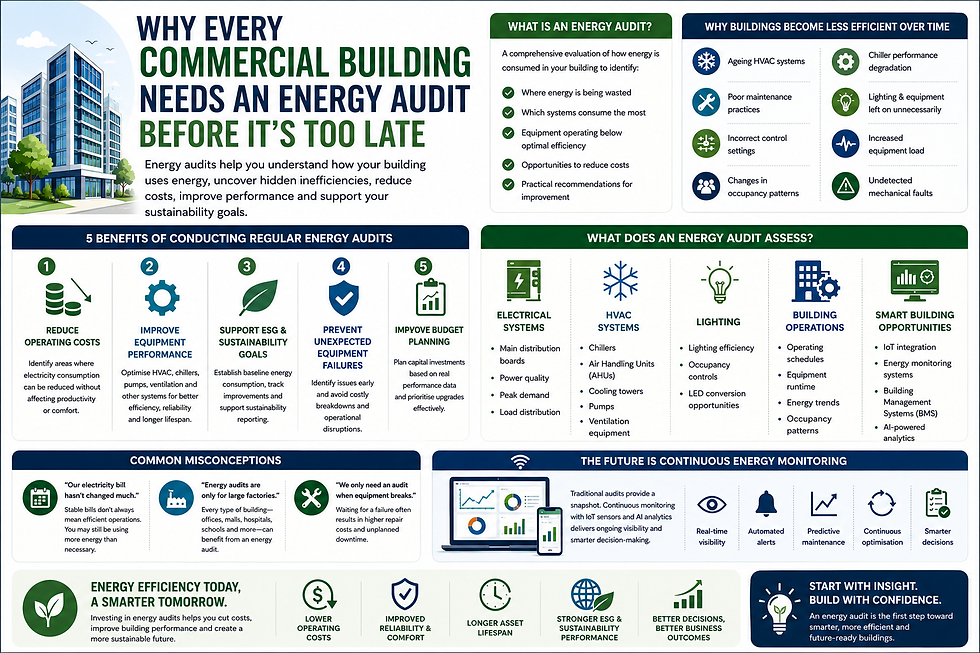
What Is an Energy Audit?
An energy audit is a comprehensive evaluation of how electricity is consumed throughout a building.
The objective is to identify:
Where energy is being wasted
Which systems consume the most electricity
Equipment operating below optimal efficiency
Opportunities to reduce operating costs
Practical recommendations for energy improvement
Rather than relying on assumptions, an energy audit uses actual operational data to identify improvement opportunities.
Why Buildings Become Less Efficient Over Time
Even well-designed buildings naturally lose efficiency as they age.
Several factors contribute to increasing energy consumption, including:
Ageing HVAC systems
Chiller performance degradation
Poor maintenance practices
Lighting systems that remain operational after office hours
Incorrect control settings
Increased equipment load
Changes in occupancy patterns
Undetected mechanical faults
Because these issues develop gradually, they often remain unnoticed until electricity bills become significantly higher.
Five Benefits of Conducting Regular Energy Audits
1. Reduce Operating Costs
The most immediate benefit is identifying areas where electricity consumption can be reduced without affecting productivity or occupant comfort.
Simple operational adjustments often generate meaningful cost savings.
2. Improve Equipment Performance
Energy audits evaluate the efficiency of major building systems, including:
HVAC equipment
Chillers
Pumps
Ventilation systems
Electrical distribution
Lighting systems
Optimising these assets improves reliability while extending their operational lifespan.
3. Support ESG and Sustainability Goals
Many organisations are now expected to demonstrate measurable environmental performance.
Energy audits help establish baseline energy consumption, monitor improvements and provide valuable data for sustainability reporting.
Reducing electricity consumption also contributes to lower greenhouse gas emissions.
4. Prevent Unexpected Equipment Failures
Equipment rarely fails without warning.
An energy audit often identifies:
Abnormal power consumption
Equipment operating beyond design capacity
Declining efficiency
Mechanical wear
Poor system balancing
Addressing these issues early reduces costly emergency repairs and operational disruptions.
5. Improve Budget Planning
Knowing which assets require upgrading allows organisations to plan capital expenditure more effectively.
Instead of reacting to failures, facility managers can prioritise investments based on measurable performance data.
What Does an Energy Audit Typically Assess?
A professional energy audit evaluates multiple aspects of building performance, including:
Electrical Systems
Main distribution boards
Power quality
Peak demand
Load distribution
HVAC Systems
Chillers
Air Handling Units (AHUs)
Cooling towers
Pumps
Ventilation equipment
Lighting
Lighting efficiency
Occupancy controls
LED conversion opportunities
Building Operations
Operating schedules
Equipment runtime
Energy consumption trends
Occupancy patterns
Smart Building Opportunities
IoT integration
Energy monitoring systems
Building Management Systems (BMS)
AI-powered analytics
Common Misconceptions About Energy Audits
"Our electricity bill hasn't changed much."
Stable utility bills do not necessarily indicate efficient operations.
Buildings may still consume more energy than necessary due to outdated equipment or inefficient operating practices.
"Energy audits are only for large factories."
Commercial offices, hotels, hospitals, universities, shopping centres and residential developments all benefit from understanding their energy performance.
Every building has opportunities for improvement.
"We only need an audit when equipment breaks."
Waiting until equipment fails often results in higher repair costs and unplanned downtime.
Regular audits help identify issues before they become expensive problems.
The Future Is Continuous Energy Monitoring
Traditional energy audits provide a snapshot of building performance at a specific point in time.
Today, organisations are increasingly combining periodic audits with continuous energy monitoring through IoT sensors and AI-powered analytics.
This approach enables:
Real-time visibility into energy consumption
Automated alerts for abnormal equipment performance
Predictive maintenance
Continuous optimisation
Better operational decision-making
Rather than reviewing performance once every few years, organisations can monitor building efficiency every day.
How IS Ikhlas Suci Supports Smarter Energy Management
At IS Ikhlas Suci, we believe that effective energy management begins with understanding how buildings consume energy.
Our team combines engineering expertise with AI, IoT and smart facility technologies to help organisations:
Conduct comprehensive energy assessments
Identify operational inefficiencies
Optimise HVAC performance
Reduce electricity consumption
Improve equipment reliability
Support ESG and sustainability objectives
Our goal is not only to lower energy costs but also to create smarter, more resilient buildings prepared for the future.


Comments